
 English
  Українська
  Čeština
 Few brewing devices have earned as devoted a following as the AeroPress. It’s compact enough to fit in a jacket pocket, forgiving enough for beginners, and versatile enough to keep experienced brewers experimenting for years. If you only own one manual brewer, a strong case can be made that this should be it.
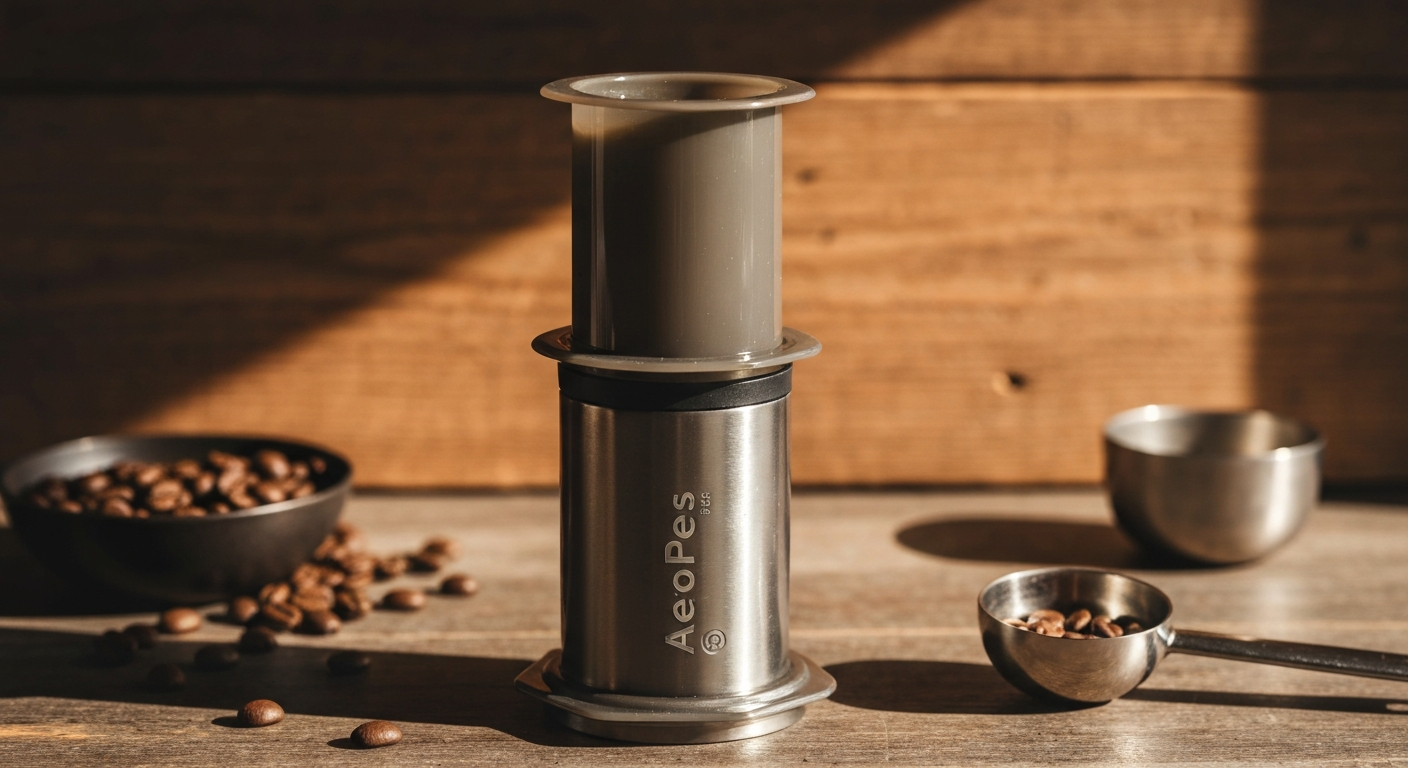
The AeroPress combines immersion and pressure brewing in a format small enough to travel anywhere
A Brief History
The AeroPress was invented by Alan Adler, an American engineer at Stanford best known for designing the Aerobie flying ring. Adler was frustrated with how long it took to brew a single cup of coffee, and in 2005 he released the AeroPress — a simple plastic cylinder with a plunger and a filter cap that brews under mild pressure.
It became an unlikely cult object. Specialty coffee professionals who initially dismissed a plastic brewer from a toy company came to respect what it could produce. By 2008, the first AeroPress World Championship had been held, and today the competition draws entrants from dozens of countries, each presenting a wildly different recipe using the same device. The World Aeropress Championship remains the most creatively anarchic event in the coffee competition calendar.
How It Works
The AeroPress is fundamentally an immersion brewer with a pressure assist. Ground coffee sits in the cylindrical chamber, steeping in hot water — similar to a French press. The key difference is the plunger: when you press it down, air pressure forces water through the grounds and through a paper (or metal) filter at the bottom, extracting more completely than gravity alone would manage.
The pressure involved is modest — around 0.35 to 0.75 bar, far below the 9 bar of an espresso machine — but it’s enough to produce a full-bodied, concentrated cup with very little bitterness. The paper filter also removes the oils and fine particles that a French press leaves behind, giving the AeroPress a cleaner result than its metal-mesh peers.
The Standard Recipe
This is a reliable starting point that produces a balanced, clean cup.
Equipment: AeroPress, paper filter, kettle, scale, timer, mug
Recipe:
- Coffee: 15g, medium-fine grind (slightly coarser than espresso)
- Water: 200ml at 93°C (200°F)
- Total brew time: approximately 1 minute 45 seconds
Method:
- Place a paper filter in the filter cap and rinse it with hot water. This removes papery taste and preheats the chamber.
- Assemble the AeroPress in standard (upright) position on your mug, plunger removed.
- Add 15g of ground coffee.
- Start your timer and add 200ml of water at 93°C, pouring slowly and evenly to saturate all the grounds.
- Stir gently for 10 seconds.
- At 1:00, insert the plunger and begin pressing slowly and steadily. Aim to complete the press by 1:30–1:45. Stop when you hear a hissing sound — that’s air, not coffee.
- The result is a concentrate you can drink straight or dilute to taste.
The Inverted Method
The inverted method has become almost as popular as the standard approach, particularly among AeroPress enthusiasts who want more control over steep time. The idea is to flip the device upside down — plunger at the bottom, filter cap removed — so coffee cannot drip through during steeping.
Why inverted? In the standard method, a small amount of coffee drips through the filter during the steep phase before you press. The inverted method prevents this entirely, giving you a cleaner immersion period.
Inverted recipe:
- Insert the plunger just a few centimetres into the chamber (to seal it) and flip the AeroPress upside down, plunger facing down.
- Add 15g of coffee. Pour 200ml of 93°C water. Stir.
- Attach the filter cap (with a pre-rinsed filter) to the top of the chamber.
- At 1:00, carefully flip the AeroPress onto your mug and press slowly over 30–45 seconds.
The trade-off is that flipping a container full of hot water requires confidence. Practice with cool water before your first inverted brew.
Variables to Adjust
Once you’re comfortable with either recipe, you have four main levers to pull.
Grind Size
Medium-fine is the default. Grinding finer increases extraction and body but can make pressing harder and introduce bitterness. Grinding coarser decreases extraction and produces a lighter, cleaner cup that finishes pressing faster. If your cup tastes bitter or your press is very difficult, go coarser. If it tastes weak or thin, go finer.
Water Temperature
93°C is the standard recommendation, but the AeroPress is forgiving across a wide range. Lighter roasts often benefit from higher temperatures (94–96°C) to extract the brighter, more complex flavour compounds. Darker roasts can be brewed cooler (88–91°C) to reduce harshness. Some AeroPress World Championship recipes use temperatures as low as 75°C with extended steep times.
Steep Time
The standard recipe uses about 60 seconds of steeping. Longer steeps increase extraction and strength; shorter steeps produce lighter cups. The plunger press itself also contributes to extraction, so a slow, deliberate press on a shorter steep can deliver similar results to a fast press on a longer one.
Coffee-to-Water Ratio
15g/200ml gives roughly a 1:13 ratio — a mild to medium-strength concentrate. Increase to 18g for more body, drop to 12g for something lighter. The AeroPress naturally produces a concentrate that you can dilute with hot water after pressing, effectively making an Americano-style drink at whatever strength you prefer.
Travel Use
The AeroPress ships with a carrying bag and fits inside its own filter holder. It’s lightweight (around 200g), unbreakable under normal use, and produces a cup that rivals home espresso setups at a fraction of the cost and bulk. It’s become standard kit for specialty coffee travellers, cyclists, hikers, and anyone who refuses to accept bad hotel coffee. The only requirement is a way to heat water.
AeroPress World Championships
The World AeroPress Championship (WAC) is held annually, rotating cities each year. Competitors are judged blind by a panel of tasters — no points for creativity, only for the coffee in the cup. The result is a freewheeling competition where winning recipes have used temperatures from 60°C to boiling, steep times of 20 seconds to 5 minutes, and bizarre additions like cold water poured over ice. Championship recipes are published openly online and serve as a useful source of inspiration for anyone willing to experiment beyond a standard method.
Where to Go Next
- Grind Size Guide — understanding how grind affects AeroPress extraction
- Water Temperature for Brewing — the science behind temperature choices
- Coffee Freshness Guide — the beans matter as much as the method
Enjoyed this article?
Get new coffee guides delivered to your inbox.
No spam, ever. Unsubscribe anytime.
Related Topics
Pour Over
Pour-over is a manual coffee brewing method using paper filters and controlled water flow, producing clean, nuanced cups that reveal single-origin character.
brewingHario V60 Pour Over
The iconic cone-shaped dripper that rewards technique and precision — a guide to pulse pouring, recipes, and getting the most from the V60.
brewingCoffee Cupping
The universal language of coffee evaluation — how professionals cup coffee using SCA standards, and how you can apply the same protocol at home to sharpen your palate.
brewingChemex
A design icon since 1941, the Chemex uses thick bonded filters to produce an ultra-clean, bright cup that highlights the delicate nuances of light-roasted coffee.