
 English
  Українська
  Čeština
 The single most impactful decision you can make for your daily cup — short of buying better coffee in the first place — is whether you grind beans yourself or buy pre-ground. This isn’t about gatekeeping or equipment obsession. It comes down to chemistry: grinding coffee triggers a rapid flavour-loss process, and understanding that process tells you exactly when whole bean is worth the effort and when pre-ground is a reasonable call.
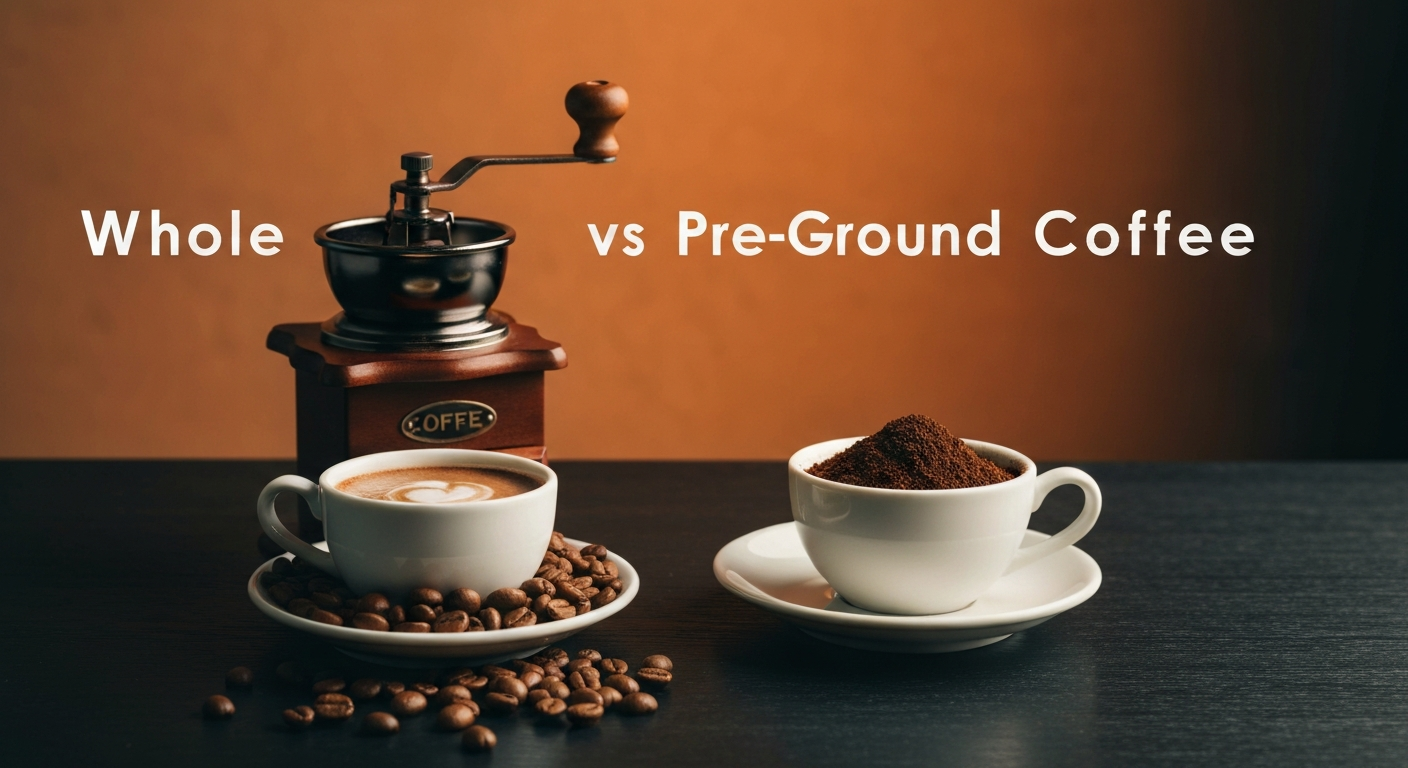
The same beans, seconds apart in time — but their flavour trajectories diverge the moment the grinder runs
What Happens the Moment You Grind
A whole coffee bean is a relatively stable structure. Its oils and aromatic compounds are locked inside a dense cell matrix, protected from oxygen. The bean loses freshness gradually — over days and weeks — but the cellular structure acts as a barrier.
Grinding shatters that structure. Where a whole bean has a surface area of roughly 6 cm², the same bean ground to filter fineness has a surface area closer to 6,000 cm² — a 1,000-fold increase in exposure to air. Oxidation, which degrades the volatile aromatic compounds that give coffee its flavour, now proceeds at a dramatically accelerated rate.
The numbers are stark: ground coffee loses a significant portion of its volatile aromatics within 15–30 minutes of grinding. Within an hour, the most delicate top notes — the floral, fruity, and bright citrus characteristics that specialty roasters work hard to preserve — are largely gone. Pre-ground coffee sealed in a bag is, by the time it reaches your kitchen, a shadow of what it was at the moment of grinding.
The Case for Whole Bean
The argument for whole bean is simply this: you grind immediately before brewing, which means extraction begins before significant oxidation has occurred. Every volatile aromatic compound that was present in the bean is still present in the grounds when hot water hits them.
This matters most for:
- Light and medium roasts, where delicate fruity and floral notes are the point. These characteristics are the first to oxidise and the most noticeable when they’re gone.
- High-quality single-origin coffees, where you’re paying for the specific character of a particular farm or region. Pre-grinding erases much of that specificity.
- Filter methods (pour-over, AeroPress, French press), where the flavour complexity of the coffee is on full display without the masking effect of milk or high pressure.
Whole bean also gives you control over grind size. Different brew methods require different grinds — coarse for French press, medium for drip, fine for espresso. Pre-ground coffee is usually calibrated for one general use case (typically “drip”) and is a poor match for everything else.
When Pre-Ground Actually Makes Sense
Pre-ground isn’t always the wrong choice. There are real situations where it’s practical:
You don’t have a grinder and aren’t ready to buy one. Pre-ground coffee brewed fresh, from a bag purchased recently, is better than whole bean coffee that’s months old. Freshness of the roast still matters even with pre-ground. Check for a roast date (not just a best-by date) and buy from a local roaster who grinds to order when possible.
You’re travelling or staying somewhere without a grinder. A small bag of pre-ground is perfectly reasonable for a hotel room AeroPress or travel pour-over kit.
You’re brewing espresso and don’t own a high-quality grinder. Espresso requires an extremely fine and consistent grind. A mediocre burr grinder producing inconsistent fine grounds can actually produce worse espresso than a decent pre-ground calibrated for espresso. If you’re using an entry-level espresso machine at home and don’t yet own a proper espresso grinder, this is one of the few cases where pre-ground can be a pragmatic choice.
The coffee is for a large group and you need convenience. Batch-brewing for 20 people with pre-ground from a freshly opened bag is a reasonable trade-off.
Grinder Types: Blade vs Burr
If you’re committing to whole bean, you need a grinder. The choice comes down to blade grinders and burr grinders, and this distinction matters more than most people realise.
Blade Grinders
Blade grinders use a spinning blade — similar to a food processor — to chop the beans. They’re cheap (usually $15–30) and widely available.
The problem is consistency. A blade grinder produces a chaotic mix of particle sizes: some powder-fine, some nearly whole. When you brew, the fine particles over-extract (producing bitterness) while the coarse chunks under-extract (producing sourness). The result is a muddled cup that contains both defects simultaneously.
Blade grinders also generate heat from friction, which can slightly degrade aromatics during grinding.
Burr Grinders
Burr grinders use two abrasive surfaces (burrs) to crush coffee to a consistent particle size. They produce uniform grounds — all particles are roughly the same size — which means the entire bed extracts at the same rate. The result is a cleaner, more balanced cup.
Burr grinders come in two forms:
- Flat burrs: Two parallel, ring-shaped abrasive plates. Tend to produce very consistent grind size and are common in commercial and high-end home grinders.
- Conical burrs: A cone-shaped inner burr rotating inside a ring-shaped outer burr. Slightly more forgiving of bean size variation; common across the price range from budget to premium.
Entry-level burr grinders for filter coffee start at around $40–60 (e.g., Timemore C2, 1Zpresso JX-Pro for hand grinders; Baratza Encore for electric). For espresso, expect to spend $150+ to get consistent fine grinding — espresso is unforgiving of grind inconsistency.
Starting with Whole Bean on a Budget
You don’t need to spend hundreds to get into whole bean grinding. A practical entry path:
-
Buy a hand grinder. Manual burr grinders like the Timemore C2 (
$50) or Hario Slim ($35) produce surprisingly good filter grinds and are far better than any blade grinder. They take 60–90 seconds of grinding per cup, which many people find is a reasonable trade-off for the quality gain. -
Ask your roaster to grind fresh when you visit. If you go to a local roaster in person, ask them to grind your whole bag fresh on their commercial grinder. Brew all of it within 5–7 days. This gets you much of the benefit of fresh grinding without owning a grinder.
-
Start with filter methods. Pour-over and French press are more forgiving of grind consistency than espresso, which makes them the right starting point while you’re calibrating a new grinder.
-
Upgrade incrementally. Once you’ve decided that fresh grinding is worth it — and most people do — you can invest in a better grinder. Grinders hold their value well and can often be bought secondhand.
The Bottom Line
If you’re brewing specialty coffee at home and want to taste what you’re paying for, whole bean with a burr grinder is the clear choice. The freshness difference is not subtle — it’s the difference between a coffee that tastes like the bag describes and one that tastes like vaguely flavoured hot water.
If you’re not ready to buy a grinder, buy from a local roaster, have them grind fresh, and use the coffee within a week. That’s still meaningfully better than a supermarket bag of pre-ground that was ground months ago.
Pre-ground has its place — convenience, travel, budget constraints. But it’s the trade-off to understand, not the default to settle for.
Where to Go Next
- Coffee Freshness Guide — how roast date and storage affect flavour, regardless of grind choice
- Grind Size Guide — matching grind setting to brew method
- Brewing Variables — the other levers that affect extraction quality
Enjoyed this article?
Get new coffee guides delivered to your inbox.
No spam, ever. Unsubscribe anytime.
Related Topics
The Coffee Belt
The Coffee Belt spans the tropics between Cancer and Capricorn, home to all 70 coffee-growing nations and every Arabica and Robusta variety on Earth.
getting-startedThe Legend of Kaldi — Coffee's Ethiopian Origins
The story of Kaldi the goat-herder, the earliest written records of coffee in Ethiopia and Yemen, and the Kaffa region as the birthplace of Coffea arabica.
getting-startedWhat is Coffee Brewing?
Coffee brewing extracts soluble flavour from roasted grounds using water — and grind size, temperature, time, and ratio all determine whether the cup sings or disappoints.
getting-startedWhat is Coffee Origin?
Coffee origin is the story of place — altitude, soil, and climate shape every flavour note. From Ethiopian florals to Colombian caramel and Kenyan citrus.