
 English
  Українська
  Čeština
 Grind size is the most immediate variable you can change in coffee brewing — and the one with the biggest impact on flavour. Everything else being equal, a coarser grind produces an under-extracted cup (sour, thin, watery); a finer grind produces an over-extracted one (bitter, astringent, dry). Understanding the spectrum from extra-coarse to extra-fine gives you the map you need to navigate every brew method with confidence.
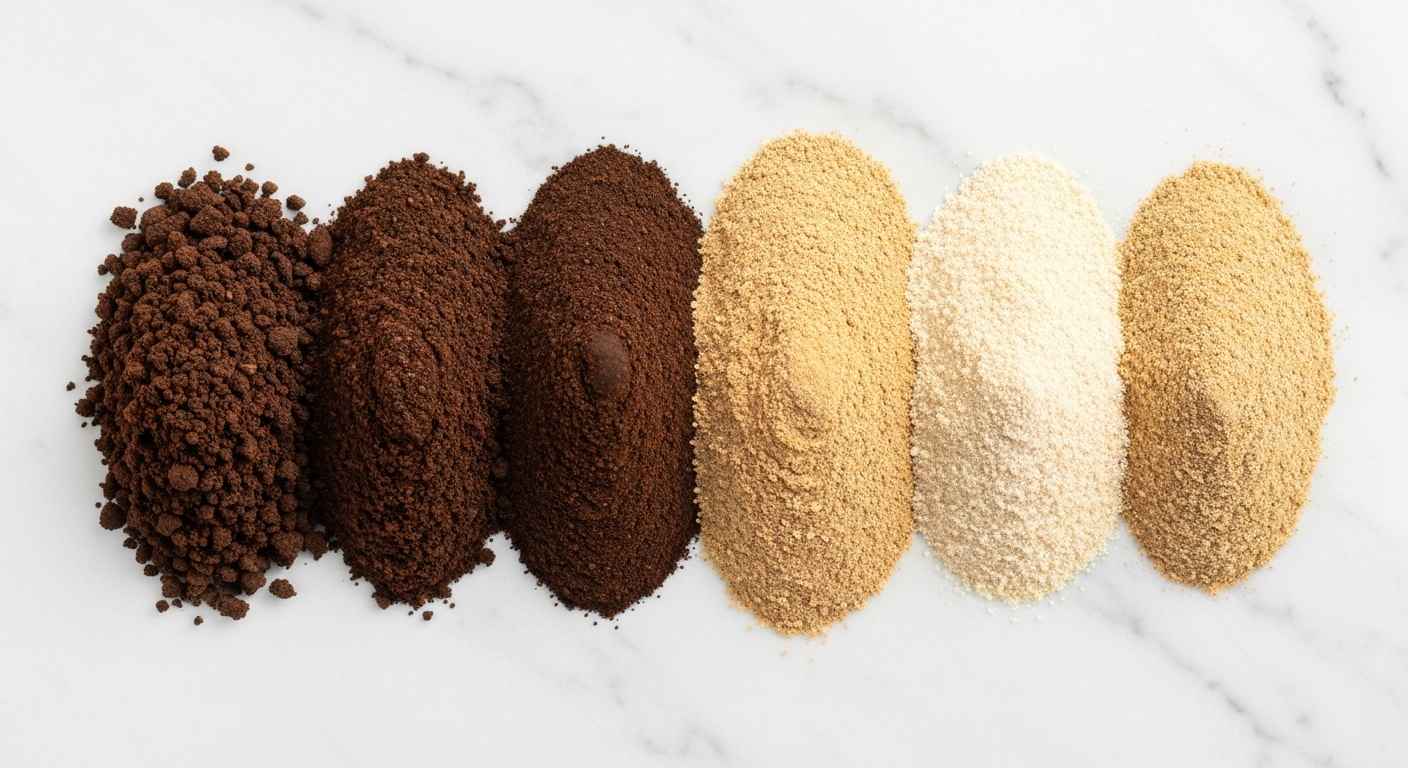
The grind spectrum from extra-coarse (left) to extra-fine (right) — each step changes how quickly water extracts solubles from the grounds
Why Grind Size Controls Flavour
When hot water meets coffee grounds, it dissolves soluble compounds — acids, sugars, oils, bitter compounds — in a sequence. Acids and fruity notes extract first, sweetness and body in the middle, and bitterness and astringency last. The size of your ground particles controls how quickly that extraction unfolds.
Finer grinds have more surface area exposed to water, so extraction happens faster. Coarser grinds have less surface area, so extraction is slower. The goal of matching grind to brew method is to give the water exactly enough time with enough surface area to land in the balanced middle of the extraction curve — capturing sweetness and complexity before bitterness takes over.
The Seven Grind Levels
Extra-Coarse — Cold Brew
Particle size: ~1.5–2 mm (coarser than sea salt)
Extra-coarse grounds are chunky, almost granular. They are designed for cold brew, where room-temperature or refrigerated water extracts very slowly over 12–24 hours. The extended contact time compensates for cold water’s low extraction efficiency — but if the grind were any finer, over-extraction and bitterness would accumulate during that long steep.
Too coarse: The cold brew tastes flat, watery, and lacking sweetness — the water simply cannot pull enough from the grounds even over 24 hours. Too fine: After 12–18 hours, bitter and astringent compounds dominate; the result tastes harsh and hollow despite its strength.
Coarse — French Press
Particle size: ~0.8–1.2 mm (similar to coarse sea salt)
Coarse grounds suit the French press’s full-immersion method, where grounds steep in hot water for 4 minutes before the plunger separates them. A coarse grind slows extraction enough that the 4-minute steep hits the sweet spot without turning bitter, and it prevents fine particles from slipping through the metal filter into your cup.
Too coarse: After 4 minutes, the cup tastes sour, thin, and under-developed — not enough extraction. Too fine: The press produces a gritty, over-extracted cup, and you may struggle to push the plunger down at all.
Medium-Coarse — Chemex
Particle size: ~0.6–0.9 mm (slightly finer than coarse)
The Chemex uses a thick paper filter that flows slowly, giving water more contact time than a standard pour-over. A medium-coarse grind compensates — it keeps flow moving through the dense filter while allowing enough extraction during the extended pour. Target brew time is 4–5 minutes for a standard 400 ml cup.
Too coarse: Brew finishes too fast (under 3 minutes) and tastes weak and sour. Too fine: The thick Chemex filter clogs; brew time extends past 6 minutes and bitterness builds.
Medium — Drip / Filter Machine
Particle size: ~0.5–0.7 mm (coarseness of table salt)
Automatic drip machines use pre-set water temperature and flow rates, so they need a consistent, middle-of-the-road grind. Medium grind is the default recommendation for most filter machines — it gives a total brew time of 5–8 minutes depending on the machine, producing a clean, approachable cup.
Too coarse: Machine brews quickly but extraction is low; coffee tastes flat. Too fine: Machine struggles, or brews very slowly and over-extracts; flavour turns bitter.
Medium-Fine — Pour-Over (V60, Kalita Wave)
Particle size: ~0.35–0.5 mm (slightly finer than table salt)
Pour-over methods give you control over every pour, and medium-fine grind rewards that control. With a V60 or Kalita Wave, you’re aiming for a 2.5–3.5 minute total brew time using 200–250 ml of water. The medium-fine particle size creates just enough resistance in the filter to let flavour compounds develop fully during each pour.
Too coarse: Brew runs through in under 2 minutes, tasting sharp, sour, and underdeveloped. Too fine: Coffee chokes the filter; brew drags past 5 minutes and over-extracts to bitterness.
Fine — Espresso
Particle size: ~0.2–0.3 mm (slightly coarser than flour)
Espresso forces hot water through densely packed grounds at 9 bars of pressure in 25–30 seconds. This extremely rapid extraction requires very fine grounds — the resistance they create gives the pump pressure something to work against, and the fine particles extract quickly under pressure. This is the grind level where small changes (a single click on most grinders) produce noticeable flavour differences.
Too coarse: Shot runs fast (under 20 seconds), tastes sour and watery — a “blonde” pull. Too fine: Shot chokes or doesn’t flow; channelling occurs; result is bitter and unpleasantly sharp.
Extra-Fine — Turkish Coffee
Particle size: ~0.1 mm (powder-like, similar to flour or talc)
Turkish coffee — brewed in a small cezve/ibrik, brought to a near-boil — requires grounds ground to a powder. The grounds are not filtered; they settle to the bottom of the cup. This ultra-fine grind means the brief boiling extracts efficiently despite the very short brew time. Only a traditional burr grinder or a dedicated Turkish setting can reliably reach this size.
Too coarse: Grounds float and do not settle; the texture is unpleasant and flavour weak. Too fine (impossible in practice): Not typically an issue — the finer the grind for Turkish, the better the settlement and flavour.
How to Diagnose Your Grind
If you taste sourness, sharpness, or a hollow thin body — grind finer. The water is moving through too quickly, leaving sugars and body behind.
If you taste bitterness, dryness, or an astringent finish — grind coarser. The water has spent too long on the grounds and pulled undesirable compounds.
If the cup tastes balanced — sweet, bright, with a clean finish — your grind is dialled in. Note the setting and don’t change it until you switch beans.
The Role of Your Grinder
Grind settings are only as meaningful as your grinder is consistent. Blade grinders chop randomly, producing a mix of fine dust and large chunks — this simultaneous under- and over-extraction is why blade-ground coffee often tastes muddled. Burr grinders (whether flat or conical) crush beans between two abrasive surfaces set at a fixed distance, producing a much more uniform particle size. For any method finer than coarse, a burr grinder makes a significant, audible difference in cup quality.
Where to Go Next
- Water Temperature for Brewing — the variable that works in tandem with grind size
- Brewing Ratios Explained — how dose and water volume interact with grind
- Your First Cup — putting it all together in a single brew
Enjoyed this article?
Get new coffee guides delivered to your inbox.
No spam, ever. Unsubscribe anytime.
Related Topics
The Coffee Belt
The Coffee Belt spans the tropics between Cancer and Capricorn, home to all 70 coffee-growing nations and every Arabica and Robusta variety on Earth.
getting-startedThe Legend of Kaldi — Coffee's Ethiopian Origins
The story of Kaldi the goat-herder, the earliest written records of coffee in Ethiopia and Yemen, and the Kaffa region as the birthplace of Coffea arabica.
getting-startedWhat is Coffee Brewing?
Coffee brewing extracts soluble flavour from roasted grounds using water — and grind size, temperature, time, and ratio all determine whether the cup sings or disappoints.
getting-startedWhat is Coffee Origin?
Coffee origin is the story of place — altitude, soil, and climate shape every flavour note. From Ethiopian florals to Colombian caramel and Kenyan citrus.