
 English
  Українська
  Čeština
 Cold brew is the simplest brewing method that most people have never made at home. There’s no heat required, no special equipment needed beyond a jar and a strainer, and the result — a smooth, low-acid concentrate that keeps in the fridge for up to two weeks — is genuinely different from any other way of making coffee. The catch is time: cold brew is made with patience, not heat, and you need to plan 12–24 hours ahead.
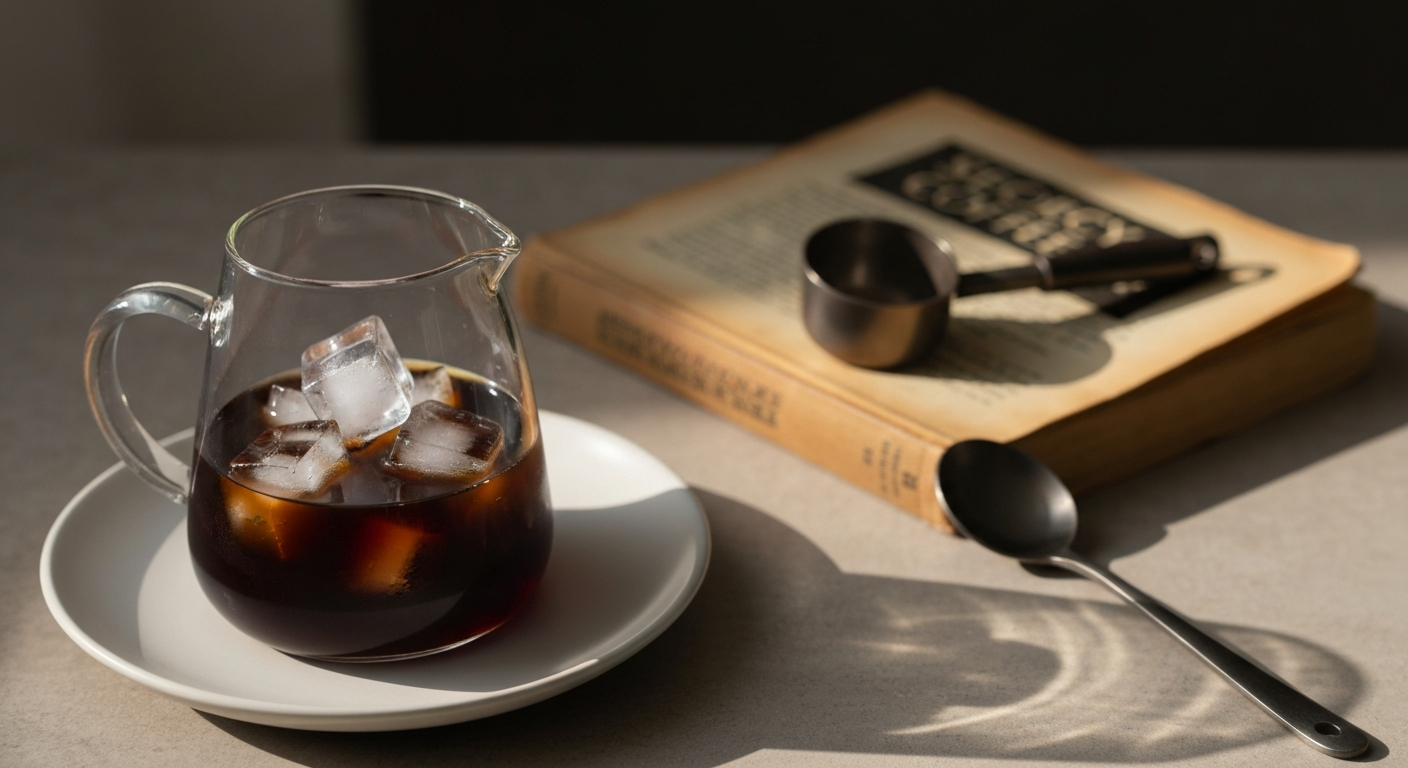
Cold brew is brewed over 12–24 hours without heat, producing a concentrate you dilute to taste before serving
What Cold Brew Actually Is
Cold brew is made by steeping coarsely ground coffee in cold or room-temperature water for an extended period — typically 12 to 24 hours — then filtering out the grounds. No heat is applied at any point. The long steep compensates for the absence of temperature: hot water extracts coffee compounds quickly (minutes), while cold water extracts them slowly (hours).
The result is a concentrate with a notably different flavour profile from hot-brewed coffee. Cold brew is often described as smooth, chocolatey, and full-bodied, with less perceived acidity and bitterness than the same beans brewed hot.
Why Cold Brew Is Less Acidic
The lower acidity of cold brew is one of its most discussed qualities, and the chemistry behind it is well-established. Hot water extracts acidic compounds from coffee grounds efficiently — particularly quinic acid, chlorogenic acids, and certain volatile organic acids that create the bright, tangy character of a well-brewed hot filter coffee. Cold water extracts these acids far less efficiently. The result is a brew with measurably lower acid content, which is why cold brew is often recommended for people who find regular coffee irritating to their stomachs.
This is also why cold brew tastes different even when made with the same beans: you’re extracting a different subset of the coffee’s flavour compounds. Some people find cold brew has less complexity than their preferred hot brew of the same beans. Others find the smoother, rounder profile more pleasant. Neither is wrong.
Concentrate vs Full Strength
Cold brew is almost always made as a concentrate, then diluted before drinking. This is more practical than brewing at serving strength — concentrate takes up less fridge space, keeps longer, and lets you adjust the final strength to taste.
Concentrate ratio: 1 part coffee to 4 parts water by weight (1:4), or roughly 250g of coffee per litre of water. This produces a strong concentrate you’ll typically dilute 1:1 with water or milk before serving.
Full-strength ratio: 1 part coffee to 8 parts water (1:8), or roughly 125g per litre. This can be drunk without dilution, similar in strength to regular drip coffee.
Unless you have a specific reason to brew at full strength, concentrate is recommended. It’s more flexible and storage-efficient.
Grind Size
Coarse grind — the same as or slightly coarser than French press. This matters more in cold brew than in almost any other method, for two reasons.
First, the long steep time means finer grinds will over-extract, producing bitter, astringent flavours even in cold water. Coarse grounds extract more slowly and stay in a pleasant range over 12–24 hours.
Second, finer grounds are much harder to filter from a cold brew. Cold brew is thick and slow to filter even with coarse grounds; fine grounds can block paper filters entirely, turning a simple process into a lengthy frustration.
Equipment
Cold brew requires less specialised equipment than any other brewing method.
The vessel: A large glass jar, a French press, a pitcher with a lid, or a dedicated cold brew maker. A 1-litre mason jar is perfectly adequate and what most people start with.
For filtering, your options are:
Paper filters produce the cleanest, most transparent cold brew. A pour-over paper filter placed over a jug, or a paper-lined fine-mesh strainer, works well. Filtering will be slow — allow 20–40 minutes. The result has almost no sediment and a clean, bright character.
Cloth filters (muslin bags, cheesecloth, dedicated cold brew bags) are reusable and faster than paper. They allow slightly more oils through, producing a fuller-bodied cup. Rinse cloth filters thoroughly after use.
Metal filters (fine-mesh strainers, French press mesh) are the fastest and easiest. They allow more oils and some fine particles through, producing a fuller, slightly thicker brew. Good for concentrate that will be diluted with milk.
Fridge vs Room Temperature
Cold brew can be steeped in the fridge (cold water, ~4°C) or at room temperature (~20°C). The difference is extraction rate and timing.
Fridge steeping: Slower extraction. Requires 18–24 hours for a concentrate. This is the safest approach — lower temperature means lower risk of bacterial growth during the steep.
Room temperature steeping: Faster extraction. 12–16 hours is usually sufficient for concentrate. Room temperature cold brew can develop slightly more acidity and complexity than fridge-steeped, as extraction is more efficient. Filter and refrigerate immediately once steeping is complete.
For most home brewers, fridge steeping is recommended. Start it before bed, strain it the next evening.
Step-by-Step Recipe (Concentrate)
Equipment: Scale, 1-litre jar, coarse grinder, filter of your choice
Recipe:
- Coffee: 125g, coarse grind
- Water: 500ml cold or room-temperature water
- Steep time: 18–24 hours (fridge) or 12–16 hours (room temp)
Method:
- Add 125g of coarsely ground coffee to your jar.
- Pour 500ml of cold water slowly over the grounds, stirring gently to ensure all the coffee is saturated.
- Cover the jar and place it in the fridge (or on the counter if using room-temp method).
- After the steep time, filter the concentrate through your chosen filter into a clean jar or bottle.
- Discard the spent grounds. Rinse the filter.
- Store the concentrate in the fridge.
- To serve: dilute 1:1 with cold water or milk over ice. Adjust to taste.
Storage: How Long Does It Keep?
Cold brew concentrate keeps in the fridge for up to 2 weeks. Full-strength cold brew is slightly less stable — aim to consume within 7–10 days. Both should be stored in a sealed container.
Cold brew does not improve with age after the first day or two. The primary risk as it ages is that it becomes progressively flatter and more oxidised — not dangerous, just less pleasant. If it smells off or sour, discard it.
Nitro Cold Brew
Nitro cold brew is cold brew infused with nitrogen gas, served on tap — the same technology used for draught stout beer. The nitrogen creates tiny bubbles that give the coffee a creamy, smooth texture and a cascade effect in the glass similar to Guinness. Nitrogen also reduces the perceived bitterness and adds a natural sweetness.
Home nitro systems exist (whipped cream charger adapters, small kegs), but they require additional equipment and introduce some complexity. Commercial nitro cold brew in cans is widely available and a reasonable way to experience the format without investment.
Cold Brew vs Iced Coffee
These are not the same thing. Cold brew is brewed cold over hours. Iced coffee is brewed hot — typically at double strength — and immediately poured over ice. The two methods produce very different results:
Cold brew: Smooth, low-acid, full-bodied, less complex, ready only after 12+ hours.
Iced coffee: Brighter, more acidic, more aromatic, ready in minutes, but can dilute quickly as the ice melts (brewing at double strength compensates for this).
Iced coffee preserves more of the volatile aromatics that evaporate with cold brew’s room-temperature or cold steep. Cold brew is smoother but can taste flat to those who prefer the brightness of a well-made pour-over. Both are worth making; they’re simply different drinks.
Where to Go Next
- AeroPress Complete Brewing Guide — a fast, hot-brew alternative with similar body
- Coffee Freshness Guide — fresh beans matter in cold brew; stale beans produce flat concentrate
- Brewing Ratios Explained — understanding coffee-to-water ratios across all methods
Enjoyed this article?
Get new coffee guides delivered to your inbox.
No spam, ever. Unsubscribe anytime.
Related Topics
Pour Over
Pour-over is a manual coffee brewing method using paper filters and controlled water flow, producing clean, nuanced cups that reveal single-origin character.
brewingHario V60 Pour Over
The iconic cone-shaped dripper that rewards technique and precision — a guide to pulse pouring, recipes, and getting the most from the V60.
brewingCoffee Cupping
The universal language of coffee evaluation — how professionals cup coffee using SCA standards, and how you can apply the same protocol at home to sharpen your palate.
brewingChemex
A design icon since 1941, the Chemex uses thick bonded filters to produce an ultra-clean, bright cup that highlights the delicate nuances of light-roasted coffee.