
 English
  Українська
  Čeština
 Ask most home brewers why their coffee sometimes tastes sour and sometimes bitter, and they’ll blame the beans or the grind. Rarely do they think about water temperature — yet it is one of the most direct levers controlling which flavour compounds extract from the coffee and which stay behind. Brew too cool and your cup tastes sharp, sour, and underdeveloped. Brew too hot and bitterness dominates. Understand the temperature window and you have reliable, repeatable control over your cup.
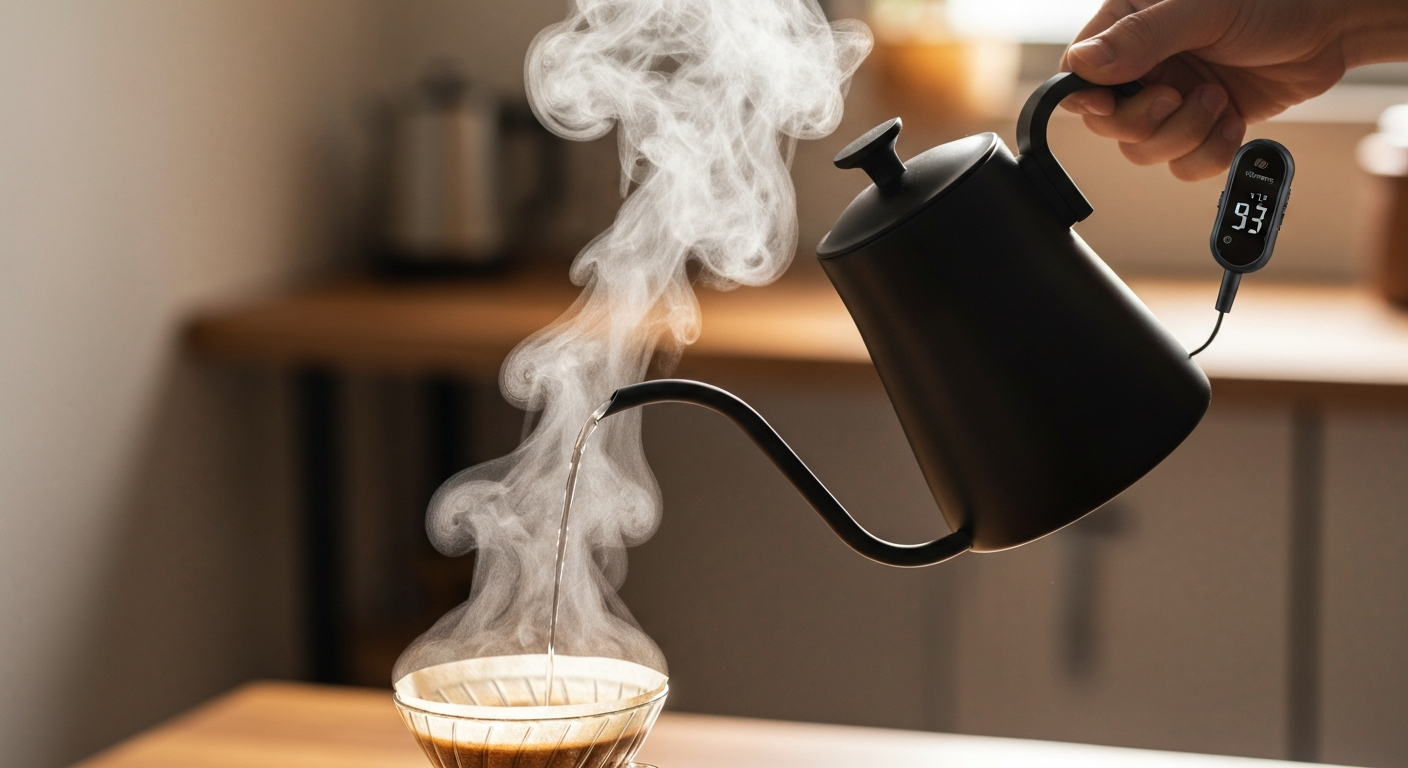
A gooseneck kettle with a built-in thermometer — or a separate probe — removes guesswork from one of brewing’s most important variables
The 90–96°C Optimal Window
The Specialty Coffee Association recommends a brewing water temperature of 90–96°C (194–205°F) for hot-brewed coffee. This range was established through sensory calibration — it consistently produces cups that reviewers find balanced, sweet, and complex rather than harsh or flat.
Why this specific window? Coffee contains hundreds of volatile flavour compounds with different solubility points. At lower temperatures, many of these compounds simply don’t dissolve efficiently into the water. At higher temperatures, compounds that contribute bitterness and astringency — including certain phenolic acids — extract more aggressively, throwing the cup out of balance.
Within the 90–96°C range, you can still make adjustments based on your beans:
- Light roasts benefit from the higher end: 93–96°C. Light roasts are denser and retain more of their origin characteristics; they need slightly more energy to extract fully without tasting thin or sour.
- Dark roasts do better at the lower end: 90–93°C. Dark roasts are more porous (cell structure breaks down during long roasting) and extract quickly; cooler water prevents over-extraction of the bitter compounds that develop during dark roasting.
- Medium roasts sit comfortably at 92–94°C for most brew methods.
Under-Extraction: When Water Is Too Cool
Under-extraction happens when water doesn’t have enough energy to dissolve the full range of flavour compounds. The result is a cup that tastes:
- Sour or sharp — acids extract first and fastest; when extraction stops early, they dominate
- Thin in body — sugars and oils that create mouthfeel haven’t fully dissolved
- Grassy or underdeveloped — certain pleasant aromatics haven’t volatilised properly
- Hollow at the finish — the cup lacks the sweetness and complexity that come from complete extraction
If your water is below 88°C, under-extraction is almost inevitable regardless of grind size or brew time. Sour coffee brewed at low temperature is not a character of the beans — it’s a symptom of insufficient heat.
Over-Extraction: When Water Is Too Hot
Over-extraction is the opposite problem — water that is too hot pulls everything from the grounds, including compounds that should stay behind. The result tastes:
- Bitter — phenolic acids and harsh tannins dominate
- Dry or astringent — an unpleasant chalky sensation on the palate
- Flat in aroma — delicate volatile aromatics have broken down or been overwhelmed
- One-dimensional — complexity collapses into a single harsh note
Water above 96°C doesn’t add a useful amount of extra extraction compared to the cost in bitterness. And boiling water (100°C at sea level) is particularly harsh — the violent agitation from active boiling itself damages delicate aromatic compounds.
Cold Brew: Extraction Without Heat
Cold brew challenges everything we’ve said about temperature — it produces an excellent cup using room-temperature or refrigerated water (18–22°C for room temp; 4°C for refrigerator cold brew). How?
The answer is time. Cold water extracts slowly but not selectively in the same way hot water does. Given 12–24 hours of contact time, cold water dissolves enough solubles to produce a concentrate that is low in acidity and perceived bitterness, smooth and sweet in texture. The compounds that create sharpness in hot-brewed coffee are simply extracted in smaller quantities at cold temperatures.
Cold brew is not under-extracted in the traditional sense — it’s fully extracted for what cold water can achieve, which is a different flavour profile from hot brew, not a lesser one. The key differences:
- Lower perceived acidity (certain acidic compounds don’t dissolve as readily in cold water)
- Higher sweetness (sugars are well-represented even at low temperature)
- Less aromatic complexity (volatile aromatics need heat to fully express themselves)
- Higher caffeine content per serving (concentrate is typically diluted 1:1 or 1:2 before serving)
Altitude and the Boiling Point
Here’s a fact that surprises many travellers who brew coffee in mountain regions: water boils at a lower temperature the higher you go above sea level. At sea level (0 m), water boils at 100°C. At 1,500 m (roughly Denver or Addis Ababa), it boils at approximately 95°C. At 3,000 m (high Andean plateau), it boils at around 90°C.
This matters if you rely on “just off the boil” as your temperature cue. At sea level, just off the boil means ~96–98°C — suitable for dark roasts but marginal for light ones. At 3,000 m, just off the boil means 90°C — the lower end of the recommended window, which may under-extract a light roast.
If you brew regularly at altitude and use a thermometer, aim for your usual 90–96°C range. The thermometer doesn’t lie; the boiling point does.
Practical Testing Tips
Use a thermometer. A simple probe thermometer or a kettle with a built-in display removes all guesswork. Digital probe thermometers accurate to ±0.5°C cost less than €12 and transform your ability to repeat and refine.
The “off the boil” shortcut. If you don’t have a thermometer, boil water and let it sit in the kettle for 30–45 seconds before pouring. At sea level, this brings the temperature from 100°C to approximately 94–96°C — well within the optimal range for most coffees.
Preheat your brewer. Ceramic, glass, and metal brewers absorb heat from your water. If you pour 94°C water into a cold V60 or AeroPress, the first contact drops temperature significantly. Rinse your brewer with hot water before brewing to stabilise its surface temperature and protect your brew temperature throughout the process.
Ice water hack for checking your grind. Brew a small amount at two different temperatures (90°C and 96°C) with the same grind and ratio. Compare side by side. If one is clearly brighter and sweeter, you’ve found your beans’ sweet spot. This kind of controlled experiment builds intuition faster than reading any guide.
Variable-temperature kettles. Gooseneck kettles with variable temperature control (typically settable in 1°C increments) are the most useful single upgrade for pour-over brewing. They solve both the temperature problem and the flow-control problem simultaneously.
Temperature and Grind Working Together
Temperature and grind size are not independent variables — they interact. A finer grind extracts more efficiently; a higher temperature also extracts more efficiently. If your cup tastes bitter and you want to cool down the water, you should also consider grinding slightly coarser to counteract the combined extraction increase. Similarly, if you drop temperature for a dark roast, a slightly finer grind may be needed to maintain full extraction.
This interdependence is why experienced brewers adjust temperature and grind together rather than treating them as separate dials.
Where to Go Next
- Grind Size Guide — the variable that works in tandem with temperature
- Brewing Ratios Explained — completing the triangle of extraction variables
- Coffee Freshness Guide — how bean freshness affects what temperature can extract
Enjoyed this article?
Get new coffee guides delivered to your inbox.
No spam, ever. Unsubscribe anytime.
Related Topics
The Coffee Belt
The Coffee Belt spans the tropics between Cancer and Capricorn, home to all 70 coffee-growing nations and every Arabica and Robusta variety on Earth.
getting-startedThe Legend of Kaldi — Coffee's Ethiopian Origins
The story of Kaldi the goat-herder, the earliest written records of coffee in Ethiopia and Yemen, and the Kaffa region as the birthplace of Coffea arabica.
getting-startedWhat is Coffee Brewing?
Coffee brewing extracts soluble flavour from roasted grounds using water — and grind size, temperature, time, and ratio all determine whether the cup sings or disappoints.
getting-startedWhat is Coffee Origin?
Coffee origin is the story of place — altitude, soil, and climate shape every flavour note. From Ethiopian florals to Colombian caramel and Kenyan citrus.