
 English
  Українська
  Čeština
 Freshness is the variable that specialty coffee shops spend the most time protecting — and the one that most home brewers overlook. You can have the finest single-origin beans from a celebrated farm, roasted by a skilled roaster, and still produce a flat, lifeless cup if those beans are three months old and stored in an open bag on a sunny windowsill. Understanding freshness means understanding how coffee changes over time and creating conditions that slow that change.
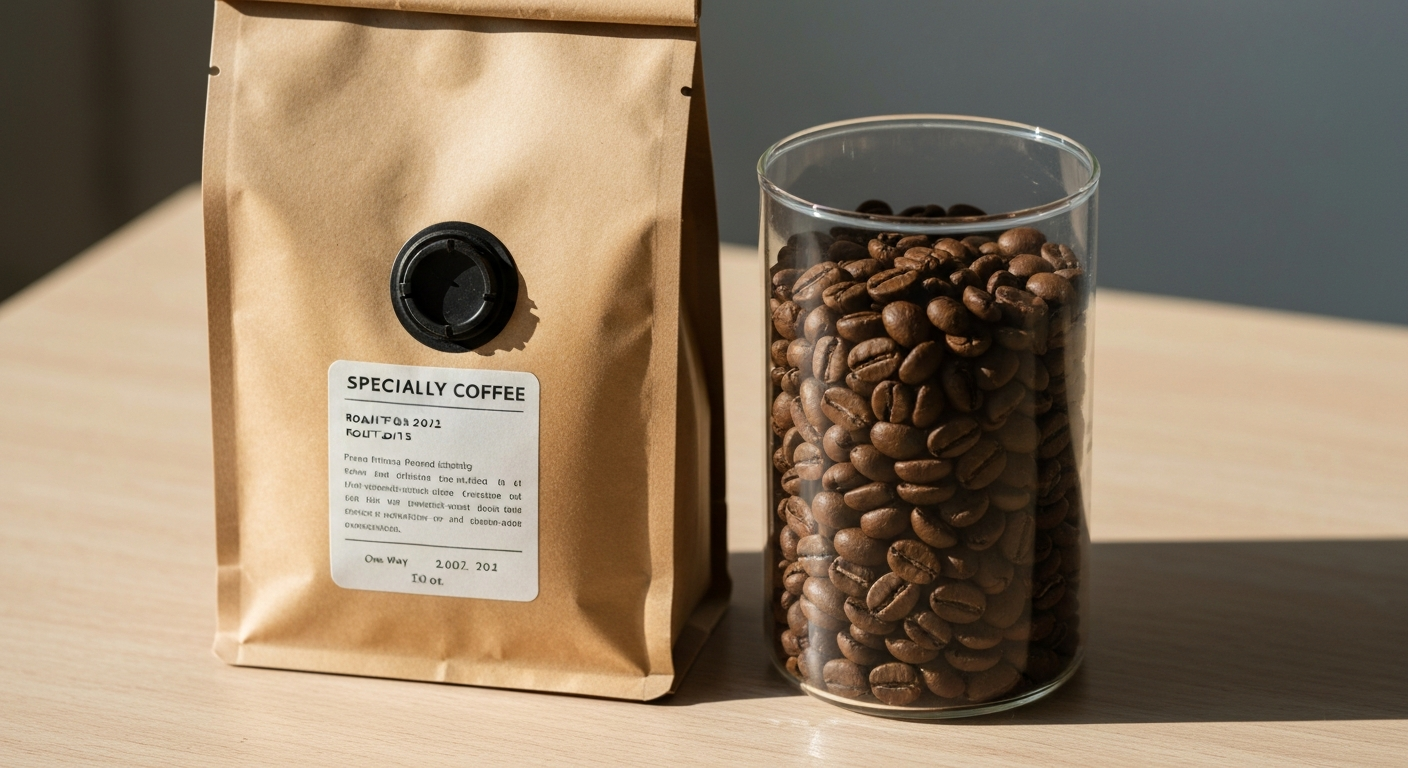
The roast date on the bag — not the best-by date — is the number that tells you whether the coffee inside is worth brewing
Roast Date vs Best-By Date
The first distinction to understand is the difference between a roast date and a best-by date. Specialty roasters print the actual roast date on their bags — a specific day the beans came out of the drum. Supermarket and commodity coffee brands typically print only a best-by date, which may be 12–24 months in the future. These are very different pieces of information.
A best-by date tells you when a roaster or manufacturer considers the product no longer sellable. It says nothing about peak flavour. A roast date tells you exactly how fresh the coffee is right now, which is the number you actually care about.
When buying specialty coffee, look for the roast date and apply this rough window:
- 0–7 days post-roast: Resting period. Fresh-roasted beans off-gas CO2 rapidly; brews made during this period are often uneven and bubbly. Espresso especially benefits from resting; filter coffee can sometimes be brewed as early as day 3–4.
- 7–21 days post-roast: Peak window. This is when the flavour compounds have stabilised, degassing has slowed, and the beans are at their most expressive. Most specialty roasters recommend brewing within this window.
- 21–45 days post-roast: Declining but still good. Coffee is losing freshness steadily but remains enjoyable if stored well.
- Beyond 45 days: Stale. The cup will taste flat, cardboard-like, and lacking in the brightness and sweetness that made the beans worth buying.
The Science of Staling: CO2 and Oxidation
Two processes cause coffee to go stale: CO2 degassing and oxidation.
During roasting, the Maillard reaction and pyrolysis produce CO2 as a byproduct. This gas is trapped inside the bean’s cell structure and slowly releases over days and weeks after roasting. In the first few days, this outgassing is so vigorous that it can interfere with extraction — CO2 escapes rapidly when water contacts the grounds (this is the bloom), physically pushing water away from the grounds before it can extract fully.
As CO2 depletes, the same microscopic channels that carried it out of the bean now allow oxygen in. Oxidation attacks the aromatic oils and compounds that create coffee’s distinctive flavour. First to go are the delicate top notes — the floral and fruity characteristics of a light roast, the bright citrus of a washed Ethiopian. What remains is a muted, flat version of the original, often with cardboard or papery off-notes.
Heat, light, moisture, and air all accelerate this oxidation. Your storage choices directly determine how quickly your beans lose what made them worth buying.
One-Way Valve Bags vs Airtight Containers
Specialty coffee bags typically feature a one-way valve — a small disc embedded in the bag that allows CO2 to escape outward but prevents oxygen from entering. This is the ideal packaging for freshly roasted beans: it handles the outgassing phase while protecting against oxidation.
Keep beans in their original bag for as long as possible. Fold the top of the bag down tightly, press out excess air, and secure it with the built-in clip or a rubber band. The valve does its job through the most critical early phase.
Once the bag is more than half empty, or if you’re transferring to a different container, use a purpose-built airtight canister. The best options are:
- Vacuum canisters (e.g., Atmos, Fellow Atmos): Remove air manually with a pump or lid mechanism. Excellent for extending freshness once CO2 has mostly degassed.
- Ceramic or opaque airtight jars: Block light as well as air. Avoid clear glass on a counter — UV light accelerates staling even through glass.
- Avoid: Fabric pouches, open bowls, decorative jars with loose-fitting lids, and anything left near the stove.
Store containers in a cool, dark location — a cupboard away from the oven or kettle is ideal. Room temperature (18–22°C) is fine; you do not need a refrigerator for beans you’re using within the week.
The Freezing Debate
Freezing coffee is one of specialty coffee’s more contentious topics. The short answer: done correctly, freezing works well. Done carelessly, it accelerates staling rather than preventing it.
The problem with freezing is condensation. When you take cold beans out of the freezer, they warm up and moisture condenses on their surface. This moisture dramatically accelerates oxidation and staling — you can ruin a bag of excellent beans in a single careless thaw-refreeze cycle.
The correct method for freezing coffee:
- Portion into single-use bags before freezing. Divide your beans into individual brew-sized portions (e.g., 30g portions for a single V60). Seal each portion completely, removing as much air as possible.
- Freeze once. Move the portioned bags straight from roaster delivery (or soon after) into the freezer.
- Thaw only what you’re about to use. Remove one portion the evening before you plan to brew. Let it come to room temperature in its sealed bag — do not open until the bag is at room temperature.
- Never refreeze. Once thawed, treat the portion as fresh and use within a few days.
Properly frozen specialty coffee can maintain very good flavour for 3–6 months. Many competition baristas freeze coffee specifically to preserve a particular lot for events months later.
Pre-Ground vs Whole Bean Shelf Life
Grinding dramatically accelerates staling. A whole bean has a relatively small surface area in contact with air; once ground, those same cells are shattered open and the total surface area increases by a factor of hundreds. Aromatic oils are now exposed directly to oxygen.
Pre-ground coffee loses most of its best characteristics within 15–30 minutes of grinding. This sounds extreme — and it is, when compared to whole beans — but it’s the reason specialty coffee shops grind fresh to order. By 30 minutes, roughly 60% of the volatile aromatics that define the coffee’s character have dissipated. By the time a pre-ground supermarket bag reaches your kitchen, weeks or months after grinding, the cup quality is a pale shadow of what it could have been.
If a grinder isn’t in your budget yet, consider buying your beans from a local roaster and asking them to grind fresh to order when you visit. This is far better than pre-packaged ground coffee. Ground coffee bought and brewed on the same day — even without a premium grinder — will outperform ground coffee that has been sitting in a sealed bag for four weeks.
Practical Buying Tips
Buy small and often. Purchase no more than you’ll use in 2–3 weeks. Buying 1 kg of beans to save money rarely results in savings if the last 400g are stale.
Read the roast date, not the packaging. Specialty roasters are proud of their roast dates and print them prominently. If a bag lists only a best-by date, that’s information worth knowing.
Subscription services. Many specialty roasters offer subscriptions that deliver beans within days of roasting, timed to your consumption rate. This is the single most reliable way to ensure freshness without thinking about it.
Support local roasters. Beans sold at a local roastery are almost always fresher than beans that have traveled through a distribution chain. The coffee you buy on the same day it was roasted will always outperform the artisan bag bought from a supermarket shelf.
Where to Go Next
- Grind Size Guide — freshness affects grind behaviour; stale beans grind differently
- How to Read a Coffee Menu — what roast date information looks like on a cafe menu
- Water Temperature for Brewing — the other freshness-related variable in extraction
Enjoyed this article?
Get new coffee guides delivered to your inbox.
No spam, ever. Unsubscribe anytime.
Related Topics
The Coffee Belt
The Coffee Belt spans the tropics between Cancer and Capricorn, home to all 70 coffee-growing nations and every Arabica and Robusta variety on Earth.
getting-startedThe Legend of Kaldi — Coffee's Ethiopian Origins
The story of Kaldi the goat-herder, the earliest written records of coffee in Ethiopia and Yemen, and the Kaffa region as the birthplace of Coffea arabica.
getting-startedWhat is Coffee Brewing?
Coffee brewing extracts soluble flavour from roasted grounds using water — and grind size, temperature, time, and ratio all determine whether the cup sings or disappoints.
getting-startedWhat is Coffee Origin?
Coffee origin is the story of place — altitude, soil, and climate shape every flavour note. From Ethiopian florals to Colombian caramel and Kenyan citrus.